
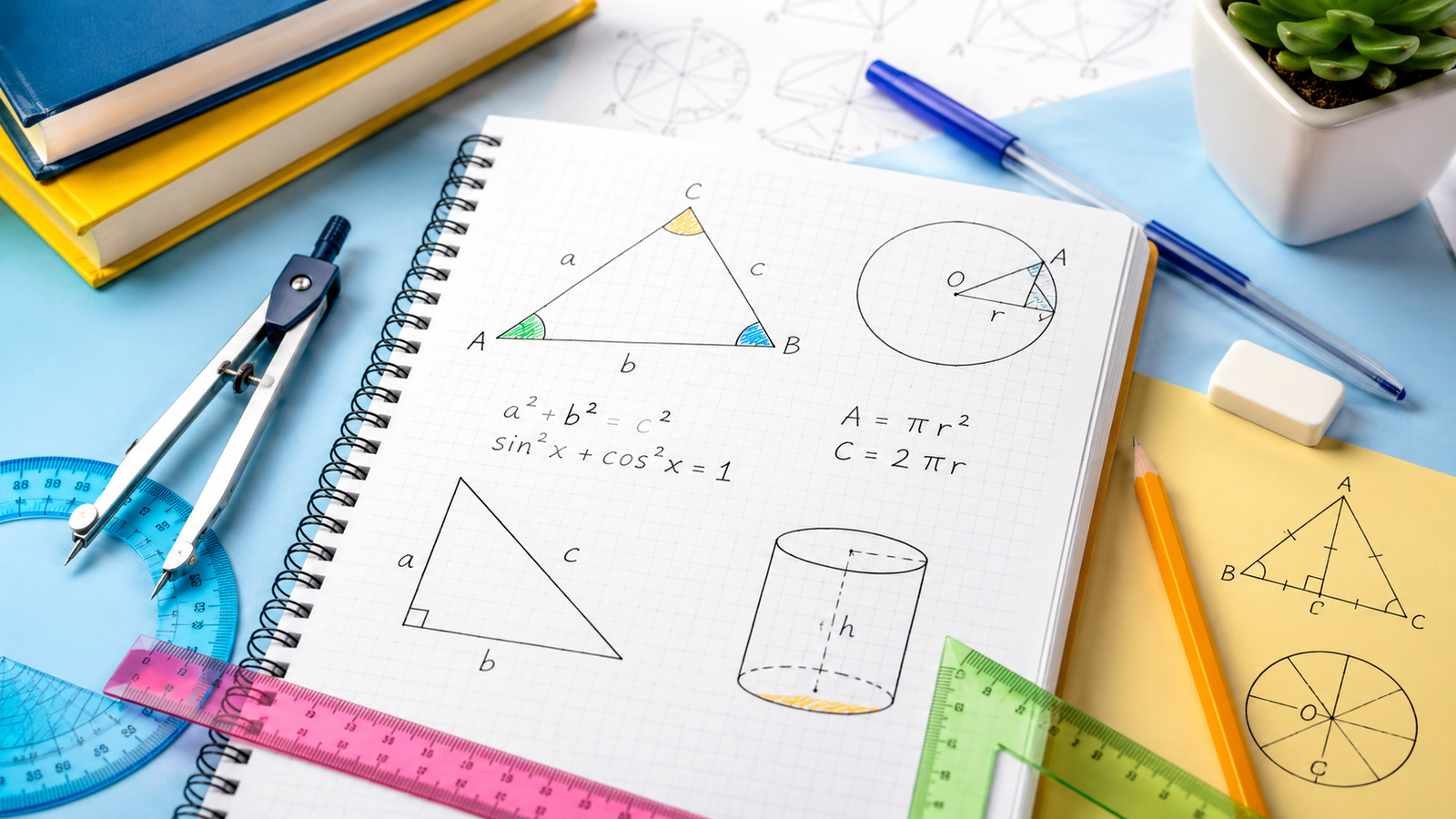
GeometryLearn is a name people are most likely to search when they want a clear, simple way to understand geometry. The interest is easy to understand. Geometry is one of the most visual parts of mathematics, but it can quickly become confusing when students meet angle rules, proofs, circle theorems, trigonometry, and exam-style diagrams.
The useful answer is that GeometryLearn should be treated as a geometry-learning concept or brand name rather than one single, fully verified public education authority. Earlier research found mixed public uses of the name, including an older education-style page and a separate site that appears more connected to games than formal maths teaching. That means students, parents, and teachers should check the exact website they are using before relying on it for study.
A strong GeometryLearn resource can still be valuable. It can explain shapes, angles, area, volume, coordinates, transformations, Pythagoras’ theorem, trigonometry, and proof in a way that feels less intimidating than a textbook. The key question is not whether the name sounds educational, but whether the content is accurate, clear, current, and matched to the learner’s level.
What GeometryLearn Is
GeometryLearn is best understood as a learning-focused term built around geometry, the branch of mathematics that deals with shapes, space, angles, measures, position, and visual reasoning. For a student, the phrase suggests a place to learn geometry step by step. For a parent, it may suggest a support tool for homework. For a teacher, it may suggest a possible extra resource for revision or practice.
The challenge is that the public information around the name is not fully unified. One result previously checked presented GeometryLearn as an educational page created to help visitors study geometry topics. Another result connected the geometrylearn.com domain with WeSlack and online games, which is very different from a structured maths-learning site.
That distinction matters because a student searching quickly may assume every result with “GeometryLearn” in the name is a trustworthy geometry platform. That would be a mistake. The safest reading is that GeometryLearn can describe a useful educational idea, but readers still need to judge the exact page, domain, authorship, and lesson quality.
A credible GeometryLearn site should clearly explain who it is for, what curriculum or level it supports, and how its lessons are organized. It should not leave users guessing whether they are using a school resource, a casual blog, a games site, or a revision guide.
Why People Search for GeometryLearn
Most readers searching for GeometryLearn want practical help, not theory. They may be stuck on a homework question, preparing for a test, helping a child revise, or looking for a simple explanation of a geometry topic they never fully understood in school. Geometry often creates stress because it asks students to think visually and logically at the same time.
A student may know the formula for the area of a triangle but still choose the wrong height. Another may remember Pythagoras’ theorem but fail to spot the right-angled triangle inside a larger diagram. These are not simple memory problems. They are understanding problems.
Parents search for resources like GeometryLearn because they want help that is easier to follow than a school textbook. Many parents can support arithmetic but feel less confident with angle rules, transformations, bearings, or trigonometry. A clear explanation can make homework less frustrating for both parent and child.
Teachers may search for similar resources when they need extra examples, topic summaries, revision tasks, or homework support links. They are likely to judge the site more strictly because one unclear explanation can create misconceptions across a whole class.
Why Geometry Is Difficult
Geometry feels different from many other parts of maths because the question is often hidden inside a diagram. In arithmetic, the task may be direct: add, subtract, multiply, or divide. In geometry, the learner must first decide what the diagram is showing, which facts are given, which rules apply, and which assumptions are unsafe.
A common mistake is trusting the look of a diagram too much. A line may appear straight, an angle may look like 90 degrees, or two lengths may seem equal. Unless the question gives that information, the student cannot assume it. Good geometry learning teaches students to read labels, marks, and written facts before making a decision.
Vocabulary also creates barriers. Words such as parallel, perpendicular, congruent, similar, tangent, chord, sector, alternate, corresponding, and hypotenuse have exact meanings. A student who half-remembers the words may choose the wrong method even when they understand the general idea.
This is where a strong GeometryLearn resource could help. It should slow the process down, show how to mark a diagram, explain why a rule applies, and make common errors visible. Good geometry teaching does not only show the answer; it teaches the habits that lead to the answer.
What a Good GeometryLearn Resource Should Cover
A useful GeometryLearn site should begin with the basics: points, lines, angles, triangles, quadrilaterals, polygons, circles, perimeter, area, and volume. These topics may seem simple, but they provide the language and confidence students need before moving into harder work. A weak foundation here makes later topics feel much harder than they need to be.
The next stage should focus on reasoning. Students need to understand angle sums, parallel-line rules, symmetry, transformations, congruence, similarity, scale factors, and constructions. These ideas train learners to explain why something is true, not just calculate a missing number.
Coordinate geometry should also have a clear place. It connects geometry with algebra through axes, coordinates, gradients, midpoints, distance, and straight-line graphs. Many students struggle here because they see it as two subjects at once, but a good lesson can show how the picture and the equation describe the same relationship.
At higher levels, GeometryLearn should cover Pythagoras’ theorem, trigonometry, bearings, circle theorems, vectors, and three-dimensional problems. These topics need careful examples because small reading errors can change the method. The most useful pages would include diagrams, worked steps, practice questions, and plain explanations of common mistakes.
Current Relevance for Students
Geometry remains highly relevant because it appears across school maths, exams, technical subjects, design, engineering, architecture, construction, computer graphics, and everyday measurement. Students may first meet it as shape recognition in primary school, but it later becomes a test of reasoning and problem solving. That makes early understanding valuable.
Recent exam support in England has also changed how some students think about formulae. For GCSE Maths in 2025, 2026, and 2027, formulae sheets were confirmed for use, meaning students do not need to memorise every listed formula in the same way. That does not make geometry easier by itself.
The reason is simple. A formula sheet can show a formula, but it cannot tell the student which formula fits the diagram. It also cannot identify the radius, choose the perpendicular height, spot a right angle, or explain why two triangles are similar.
This makes GeometryLearn-style content more useful if it focuses on application rather than memorisation. The student’s real task is to understand what the diagram is asking and how to connect the known facts to the unknown value.
Benefits and Limits of Using GeometryLearn
The main benefit of a GeometryLearn resource is focused support. A general maths website may cover every topic, but geometry has its own learning needs. Students need visual examples, diagrams, clear labels, and explanations that connect shape facts to calculation and proof.
Another benefit is access. A free or low-cost online resource can help students who cannot afford regular tutoring. It can also support learners who want to revise at their own pace, repeat explanations, or practise a topic before asking for help in class.
That said, a website has limits. It cannot always see where a student’s misunderstanding begins. A learner may keep making the same mistake without realizing it, especially in proof, trigonometry, or multi-step questions. Teacher feedback, marked work, and discussion still matter.
There is also a trust issue. Since the GeometryLearn name appears in mixed public contexts, readers should not assume that every page using the term is suitable for study. A good education site should show clear lesson structure, accurate explanations, contact details, update history, and a purpose that matches learning.
Common Misunderstandings
One common misunderstanding is that geometry is mainly about memorising formulas. Formulas are useful, but geometry depends heavily on reading diagrams, spotting relationships, and explaining reasoning. A student can know the formula and still get the question wrong if they misunderstand the shape.
Another misunderstanding is that a short answer means a good explanation. Short answers help during revision, but new learners often need a slower path. They need to see why a method works, what each label means, and where wrong approaches come from.
Some readers may also confuse games with geometry learning. Puzzle and shape-based games can support spatial thinking, but they are not the same as structured maths teaching. A student preparing for homework or exams needs direct instruction, practice, and feedback.
A final misunderstanding is that one site can replace school materials. A GeometryLearn resource can be a helpful support, but students should still use school notes, teacher advice, official specifications, and exam-board materials where relevant. The safest approach is to use online resources as support, not as the only guide.
How to Judge a GeometryLearn Site
The first thing to check is whether the site actually teaches geometry. If the page is mainly games, unrelated links, or vague study claims, it may not serve the reader’s purpose. A learning site should make its educational focus clear from the start.
The second thing to check is level. A Year 6 learner, a Key Stage 3 learner, and a GCSE Higher student do not need the same lesson. A trustworthy resource should label topics clearly so students do not waste time on material that is too easy or too advanced.
The third thing to check is accuracy. Geometry pages should use correct definitions, clear diagrams, and careful reasoning. If a page gives answers without explanation, skips steps, or uses confusing labels, students should compare it with a more reliable source.
The final thing to check is transparency. A useful site should explain who created it, when it was updated, and how users can contact the publisher. Maths facts may be stable, but exam rules, formula sheets, and curriculum expectations can change, so update care still matters.
Frequently Asked Questions
What is GeometryLearn?
GeometryLearn is a name linked to learning geometry, but it should not automatically be treated as one official education platform. Public results around the name have appeared in more than one context, including education-style material and a separate games-focused site.
For readers, the best approach is to check the exact website before using it. A real learning resource should clearly teach geometry topics and show enough information to be trusted.
Is GeometryLearn useful for students?
GeometryLearn can be useful if the site provides accurate lessons, clear diagrams, worked examples, and practice questions. It is most helpful for students who need extra support with shapes, angles, area, volume, coordinates, Pythagoras’ theorem, and trigonometry.
Its usefulness depends on the quality of the exact page. A name alone does not prove that the content is suitable for homework or exams.
Can GeometryLearn help with GCSE Maths?
A good GeometryLearn-style site can help with GCSE Maths if it explains topics at the right level and separates Foundation and Higher content. GCSE geometry often requires reasoning, not just formula recall.
Students should still compare online lessons with teacher guidance and official exam-board materials. This is especially true for exam rules, formula sheets, and topic coverage.
Is geometrylearn.com only about geometry?
Earlier checked information showed geometrylearn.com presenting content connected with WeSlack, games, apps, and online services rather than a formal geometry curriculum. That means users should not assume the domain is mainly a maths teaching site.
Anyone searching for geometry help should check the page content carefully. If it does not offer structured lessons, it may not be the right study resource.
What topics should a GeometryLearn website include?
A strong GeometryLearn site should include angles, triangles, quadrilaterals, circles, perimeter, area, volume, transformations, coordinates, Pythagoras’ theorem, trigonometry, similarity, congruence, and proof. It should also include examples that show the method step by step.
The best lessons would explain common mistakes as well as correct answers. That helps students understand the thinking behind the method.
Is GeometryLearn free?
There is no single confirmed pricing model for GeometryLearn as a verified education service. Some related pages may be free to access, but that does not mean every site using the name is free or suitable for study.
Before paying for any resource, users should check the provider, contact details, refund terms, and what the purchase includes. Free official and school-provided materials should also be considered.
Should parents trust GeometryLearn for homework help?
Parents can use GeometryLearn-style content as support if the explanations are clear and accurate. It can help when a child needs a different explanation from the one given in class.
Parents should be careful if the site lacks author details, has unrelated content, or does not show worked examples. For important tests, teacher guidance should remain the main reference.
Conclusion
GeometryLearn is a useful idea because many students need geometry explained with more patience, clearer diagrams, and less pressure. The subject can feel difficult because it combines visual reading, exact vocabulary, formulas, and logical reasoning. A well-made resource can make that process easier.
The name itself, though, should be handled carefully. Public information around GeometryLearn is not tied to one fully verified education authority, and some related results do not appear to be formal maths-learning platforms. Readers should judge the exact site, not the name alone.
The most valuable GeometryLearn resource would be simple, accurate, and honest about its purpose. It would help students understand geometry step by step, show common mistakes, and guide learners toward better reasoning.
For students, the next step is practical: use GeometryLearn-style content as a support tool, check it against trusted school or exam materials, and practise regularly. Geometry becomes less intimidating when learners stop guessing from diagrams and start reading them with confidence.